

Giorgos Pittas — 30/09/2026, No. 1741
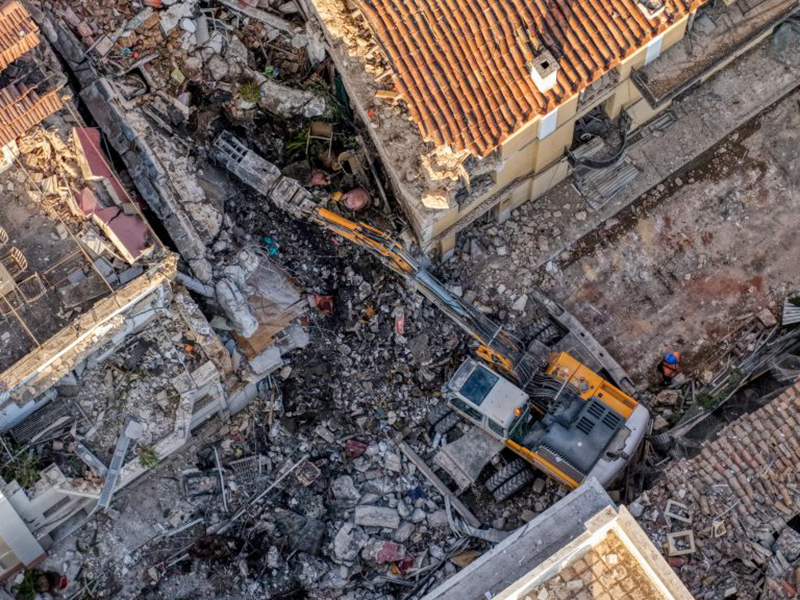
Six people ultimately lost their lives in the explosion caused by a natural-gas leak in Plaka. If the explosion had occurred an hour or two later, the number of victims in one of Athens’ busiest and most tourist-filled areas could have been much higher.
With investigations into the exact circumstances of the explosion and the collapse of the building still under way, pending the experts’ conclusions, a number of fundamental questions have already arisen and are awaiting answers.
Several concern residents’ reports that they had detected the smell of gas and had contacted the relevant authorities. “Over the past few weeks we have called about a gas leak on my street, and the investigations were stopped until November because it is still tourist season,” A. Volanakis, a local resident, wrote in a post. That such reports had been made was confirmed by Hellenic Police spokesperson Konstantia Dimoglidou, who told ERTnews that the authorities had received reports from citizens about a possible smell of gas before the incident.
In the only statement issued so far by the company responsible for managing the network, Enaon EDA, it says, among other things, that “the causes of the incident are under investigation, the relevant emergency crews immediately went to the scene, and we will provide a further update.” There is no mention of a leak or of any inspection before the incident.
Questions
The questions that arise are these: First, what did the police, who knew about the reports, do? Did they go to the site? Did they inform the Fire Service—which says it knew nothing about it—that such a report had been made? Did representatives of the company go to investigate a possible leak, or did they not? And if they did go, did they really say, “See you in November”? And if that was the company’s position, what did the police do?
The Plaka Residents’ Movement speaks in a post of a logic that puts profits above everything else. For a year, through a letter to the Fire Service and other relevant authorities, the group had been pointing out the dangers that a fire caused by a possible short circuit or gas leak could pose to the Plaka area, given its particular urban layout, old houses and narrow streets filled with tourists and cars throughout the year. The residents had even been calling for emergency preparedness drills in case such an event occurred. As the Movement stresses in a post concerning the residents’ reports, “this complaint is not the first to bring prevention issues in the area to the fore. If confirmed, this amounts to criminal negligence once again subordinated to the logic of ‘profits above everything.’”
A second category of questions concerns the collapse of the building. According to all initial assessments, the explosion occurred on the second floor, where the two elderly residents lived, although it has not yet been clarified where the leak originated—from their apartment, from the pipes, or from the main connection. The four unfortunate tourists who also lost their lives were staying on the floor below in an Airbnb.
Speaking on ERTnews’s Live Now programme, earthquake-resistant construction professor P. Karydis raised a number of issues: “According to his description, the explosion caused the ceiling to be blown out, and then the floor collapsed. ‘Why did it fall?’ This is,” he stressed, “the question that the investigation will have to answer with evidence.” He noted that, based on general knowledge and his experience with older buildings, the particular section was approximately six metres wide and, in his estimation, could have consisted of two spaces separated by an intermediate wall. “If, then, we had the wall here, I believe the floor would not have fallen; it would not have had such a large opening”... He also made particular reference to possible alterations that may have been carried out on the building. As he explained, the actual condition reconstructed from the findings should be compared with the building documentation and the permit for minor works, in order to establish what work had been carried out… He cited another case he had been called upon to examine, saying that in an apartment building used for Airbnb, an alteration had been made to a column in order to create space for a bedside table.
Judicial expert engineer Chrysanthos Nikolakos, also speaking to ERT, observed that “the routes of the pipes are not externally visible... Based on the picture available to him, he estimated that it was possible for the horizontal section of the pipe to be buried. In such a case, particular care is required, as pipes must be protected from corrosion and mechanical stress and must remain accessible so that any leak can be detected in time.”
Where the leak occurred is directly relevant to responsibility. If the leak occurred before the meter, it directly concerns the company managing the network, in this case Enaon EDA. If it occurred inside the house, it concerns whichever of the many technical companies carried out the installation, in the event of defective workmanship. But it also concerns the company managing the network, which has the right and obligation to carry out “spot checks,” as it itself states, on the internal natural-gas installations of buildings and homes.
Was such an inspection carried out at the house in Plaka? How many spot checks does each network management company conduct, and how frequently, to ensure that installations are not affected by failure, neglect of maintenance due to negligence or financial hardship, or any other cause?
At the root of the problem lies the fragmentation and privatisation of natural gas and energy, which for the past decade has become an El Dorado for “investors” who share out billions in profits—and responsibilities. One company imports and markets the country’s natural gas, another manages the national natural-gas transmission system, other companies manage the distribution networks, while still others are responsible for supply—the so-called “providers” who compete with one another in the market—while installing the infrastructure needed to bring gas to consumers is the responsibility of hundreds of technical companies. And if something goes wrong, good luck finding out who is responsible...
Who is Enaon?
In February 2024, “Italgas officially presented the new identity of the group’s Greek companies, which are now called ‘Enaon,’ the parent company, and ‘Enaon EDA,’ the subsidiary,” Capital reported at the time. “The establishment of Enaon and Enaon EDA, which will be responsible for the development and management of the networks, represents another step forward in the reorganisation process undertaken by Italgas, marked by the merger of the three previous Gas Distribution Network Operators into one, which took place in 2023,” the relevant announcement stated. “About a year ago,” Italgas’s CEO said at the time, “we successfully completed the acquisition of DEPA Infrastructure. Today, with the launch of Enaon, we are opening a new chapter.” And Environment and Energy Minister Skylakakis assured that “the initiatives being undertaken through the Italgas Group will enable the upgrading of the Greek Distribution Networks.”
The conclusion? The only way to achieve cheap and safe energy is the nationalisation, without compensation, of natural gas from production through to consumption, under workers’ control.
The chaos of the market
Beyond the preliminary investigations being conducted under the direction of the competent Athens Public Prosecutor’s Office regarding the incident in Plaka, another criminal proceeding against the network management company is also under way.
According to reports, on 26 September, lawyer Elena Tzouli (wife of P. Kammenos) and Angelos Papas submitted a supplementary memorandum to the Deputy Prosecutor of the Athens Court of First Instance in the criminal proceedings they have initiated against the chief executives and members of the boards of directors of Enaon EDA and DEPA Infrastructure “concerning the powerful explosion that occurred on 26 January 2022 on Syngrou Avenue as a result of a natural-gas leak, which resulted in the complete destruction of Ms Tzouli’s law office, requesting a judicial investigation into the network’s inspection and maintenance protocols.” Among other things, the memorandum requests “that the new case be joined to the already pending case file.”
• On the same day as the explosion in Plaka, another accident involving a gas leak nearly occurred in Palaio Faliro. Once again, the cause was the numerous incidents of damage caused by companies installing fibre-optic cables. After the EYDAP water pipelines, natural gas was next: “According to residents’ accounts, a small excavator struck an underground natural-gas pipeline with its bucket, causing a rupture. Gas began shooting from the point at high pressure to a height of almost 10 metres. In an attempt to temporarily contain the leak, the excavator operator placed the machine’s bucket over the point where the rupture had occurred. Shortly afterwards, a specialist natural-gas company crew arrived in the area and shut off the supply...” The anarchy of the market in all its “glory.”