

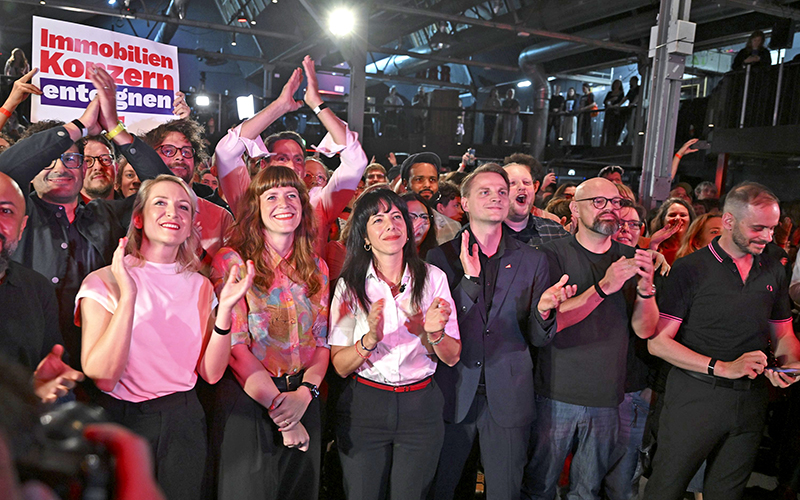
Die Linke came out as the largest party in Sunday’s elections in Berlin. According to the preliminary results, the Left, led by Elif Eralp, won 25.7%, leaving Merz’s Christian Democrats behind on 18.8%. Three years ago, it had received 12.2%. Turnout soared to 74.2%, from 62.9% in 2023. Merz himself spoke of a crushing defeat, since on the same day, in Mecklenburg-Vorpommern, his party did not even make it into the state parliament.
How did this happen? Eralp’s campaign tapped into anger over skyrocketing rents and the rise of the far right. The Financial Times compared Eralp with Zohran Mamdani, who won the New York mayoral election. And its headline used the word that terrifies the markets: “expropriation.”
This is the crucial point. Eralp did not win by promising a few more benefits or “incentives” to property owners. She stood behind a demand that originated from below, from the “Deutsche Wohnen & Co enteignen” movement: that the apartments owned by large companies with more than 3,000 homes each should be expropriated. In 2021, 59% of Berliners voted for this in a referendum. Mamdani, similarly, won with a rent freeze for hundreds of thousands of households. In both cities, the same conclusion: when the Left speaks clearly about who is stealing our homes, the working class and young people listen.
If there is a city where this language would find a response, it is Athens. Greece ranks first in Europe for the burden of housing costs on households. Young workers spend half their salary on a one-bedroom apartment or remain in their parents’ home until the age of 35, while wages remain stagnant. Neighborhoods are being emptied out for Airbnbs, the Golden Visa grants residence permits to anyone who buys property, and funds are sitting on homes they acquired for pennies from “non-performing” loans, putting them up for auction. The Mitsotakis government’s response is subsidies and “My Home”—in other words, public money ending up in the pockets of property owners and banks.
And the “progressive” opposition? It talks about slightly more incentives, mild restrictions here and there, and “social housing” sometime in the future. No one dares to say what Eralp said: that the homes should be taken away from the vultures. They are afraid of frightening the “markets” and the “investors” (Israeli companies prominently among them).
But there is another lesson from Berlin. After the 2021 referendum, the SPD-Greens-Linke government sent the issue of expropriation to an “expert commission,” where it was buried. Sunday’s victory is a huge opportunity, but it will not be decided by the “institutions.” What will determine whether the companies actually lose their homes is pressure from below, the struggles of workers and young people.
The same applies here. The answer to the housing crisis lies at the heart of the demands of the labor movement. Through strikes and mass mobilizations, we can demand—and force—the opening up of vacant homes: more than 100,000 in Attica and around 700,000 across the country, most of them in the hands of funds and banks. The Workers’ Housing Organization (OEK), abolished in 2012, should be re-established under workers’ control. Municipalities should hire staff so that every municipality has its own Planning and Building Department, putting a brake on the impunity of contractors who cover every green space in concrete. We demand wage increases, the restoration of rent caps, and controls on landlords’ profiteering. And to stop foreclosures, the banks should be nationalized under workers’ control and the working class’s non-performing loans written off.
These are not utopias. Berlin and New York have shown that when the Left dares to target the profits of the capitalists, it wins in two of the largest metropolises of capitalism. Anti-capitalism is neither a burden nor a luxury; it is the force that makes it possible to fight and win.