
Workers’ Solidarity — 02/09/2026, No. 1737
The National Council of the Socialist Workers Party (SEK) met on Sunday, August 30, to discuss the critical developments at home and internationally, as well as the tasks facing the revolutionary Left under these conditions. In a packed auditorium with delegates from the party’s local branches, a total of 39 comrades spoke following the presentations by the Central Committee, offering assessments and proposals for the way forward based on experiences and examples from activity over the recent period. On pages 3 and 12–13 of this issue, we present key points from the rich discussion that unfolded.
The beginning of this pre-election period has particularly distinctive characteristics.
It is a pre-election period of war and crisis. The crisis, being prolonged, is not something new, but the dimensions it is taking are new. All the more so because of the defining feature of war, which plays a very major role in developments and creates enormous upheavals.
Above all, this pre-election period is different because of the weakness of the opposition, the crisis affecting the parliamentary parties, and particularly the reformist Left. We are in a period when people are looking for ways to get rid of Mitsotakis, what might come next, while the answers from the parliamentary parties are restrained and leave people without answers in their search. The conditions are exceptional, and therefore we need to look at the issues emerging one by one and giving rise to these dimensions, starting with the first: the question of war.
Military dead ends
Obviously, war is the central element in the conditions that are developing, but it is also an exceptional situation because of the defeat of US imperialism in the campaign it has launched. US imperialism had been calling the shots in the Middle East throughout the previous period. It was the dominant power in the region, and Israel was the main local power through which its plans were implemented. This combination is now in retreat. This is an assessment that is not made by us alone.
We had begun speaking in this direction from the outset, ever since Trump was being portrayed as all-powerful. The erosion of this dominance began on October 7, 2023, with the Palestinian Resistance’s attack on Israel. That was the starting point of destabilization three years ago.
Israel’s response was genocide, and their first defeat begins there, with Israel’s international isolation over its genocidal attack on the Palestinians. They never anticipated that solidarity with the Palestinian people would reach the dimensions it did in the following years. It unfolded on an international scale, not only within the countries of the Middle East but at the heart of imperialism, in America and Europe.
Thus we arrived at an escalation of the imperialist attack throughout the region, with the largest attack being against Iran. When they launched this attack, their reasoning was that it was a battle US imperialism would win within a few days. We all remember them talking about a 12-day war. And even when the initial attack failed, despite bombing Tehran and assassinating the leadership, they did not get the outcome they had expected. They decided to continue the attacks, and after six months they find themselves at an impasse.
This is an issue that concerns not only Israel and what will happen to Netanyahu in the elections at the end of October, nor only Trump and his fate in the US elections in November. Obviously, they are finding things difficult because defeat in an imperialist war has consequences domestically. But the consequences also concern Mitsotakis.
In contrast to developments in the region, which show that Trump and Netanyahu cannot control the war they started, the Greek side, instead of loosening its ties with this unsuccessful American and Israeli war campaign, is moving in the opposite direction and strengthening those ties.
The vacuum created by the inability of America and Israel to win the war they started lead to a number of forces rushing to fill it. This is what the so-called “Islamic NATO” is doing. Turkey’s cooperation with Saudi Arabia and Pakistan is attempting to fill the gaps and compensate for the weaknesses of the American and Israeli offensive. There must not be the slightest doubt about this. Obviously, Saudi Arabia’s ties with US imperialism are such that it would be laughable to claim that the princes of Riyadh have suddenly become anti-imperialists. The same applies to Pakistan. The coups carried out time and again by the Pakistani state are closely tied to US imperialism.
And the third component is Turkey. This is where all the talk begins about Greece being in danger because Turkey has entered this cooperation and poses a threat to the Aegean and Cyprus. This is chauvinistic propaganda. The fact that these countries are Muslim does not mean that their cooperation constitutes Islamic NATO. It is simply NATO. It is American NATO. It is cooperation with US imperialism and Israel to help them control the situation in the Middle East. Obviously, in exchange for concessions.
An important front opening up for us is the confrontation with the propaganda claiming that developments favor Turkey and that Greece must cooperate more closely with Israel in order to confront Turkey in Cyprus and the Aegean. This is a sly attack aimed at dismantling the anti-war movement. The anti-war movement that began with solidarity for Palestine and continues against the war, US imperialism, and Israel is now being told to forget about it, because otherwise “we are playing Erdogan’s game.”
This is one of the issues emerging during this prolonged pre-election period, and it plays a very major role precisely because the opposition has surrendered to this game. In fact, they are moving like [chauvinist ex-PM] Samaras. They accuse Mitsotakis of being conciliatory, of failing to see the threat, of talking about “calm waters”; they say he is right to bring in Patriot missiles to defend the American bases. The people say “bases out,” while the opposition says “bring in the Patriot missiles to support the Souda base.”
This is the contradiction, and it concerns not only Tsipras but the entire spectrum. The Communist Party (KKE) is also moving in this direction, saying that they are preparing to divide up the Aegean. Which Aegean? The oil and natural gas that, for the KKE leadership, constitute “national wealth,” at a time when the climate catastrophe has reached tragedies like the one we are seeing in Nepal.
Economic crisis
The second dimension of the crisis is the economic crisis. Trump, unable to win the war with Iran militarily, says he will supplement the military war with economic warfare. He will impose sanctions that will crush not only Iran but anyone cooperating with it. This raises two issues. On the one hand, it constitutes an escalation of the war. There is no separation between military and economic warfare. It intensifies destabilization globally and creates new problems.
Let us look at the Greek government’s response. Mitsotakis is also escalating the war, not through sanctions, but through arms spending and attacks on workers’ rights. The largest expenditure at the moment is the agreement they are signing with Israel to build the “Achilles Shield,” the dome over the Aegean.
The situation is worsening not only because of military spending, which is the obvious factor, but also because of the dimension of the debt crisis. Government propaganda says that debt crises are over, that the memoranda are a thing of the past, which we remember only in order to see how conciliatory Tsipras was. The government is currently boasting that we have a lower borrowing interest rate on international financial markets than Italy, France, and Britain.
In reality, we need to remember what governments were saying in 2008. We had a New Democracy government then as well. “The banks in Greece,” they said, “are not at risk because an American bank is collapsing. We are protected. We have the assistance of the European Union.” We all experienced what happened next.
These stories do not belong to the past. Mitsotakis’s assurances that our situation is out of danger thanks to early debt repayments are lies. The possibility of a new debt crisis in the global economy is real, and what is driving it is the fact that the US budget is facing enormous problems.
In recent days, the news was that US public debt had reached ten trillion dollars. Under these conditions, Trump’s Finance Minister and Trump’s central bank governor are clashing. Not because they come from different backgrounds. They are two market gamblers who started out at the same fund. But now they are fighting. The central bank governor says interest rates need to rise because inflation is close to becoming uncontrollable, while the other says, “I have billions in interest payments to make; don’t raise interest rates.” Even they do not know where this story will end. They run the risk of triggering a debt crisis originating with the dollar and, from there on… God help whoever gets caught in it. France, Italy, and obviously Greece as well.
We need to have this picture in mind in order to see what the opposition is saying too. Who is talking about nationalizing the banks? None of them. Essentially, the opposition has fallen into line. Tsipras admitted that he got things wrong back then and now has the experience to know what is feasible. And behind him, everyone is adapting to the line that we do not talk about these things—not about the banks, nor ΔΕΗ (PPC), nor water, nor public transport, nor housing.
Political crisis
The third element of the period is the political crisis resulting from the military defeat and the economic crisis. Historically, this is always how it happens. When we talk in history about periods of wars and revolutions, they always have both aspects. The First World War ended in revolution. The Resistance movements during the Second World War were revolutions, even if they were drowned in blood through conciliations, such as Varkiza. The movement in America against the Vietnam War reached the point of besieging the Democratic Party convention and the Pentagon. We are returning to such circumstances now.
First of all, within the United States itself. At first, they said Mamdani’s election was an isolated incident. Now more Mamdanis are emerging in every state in America. Democratic Socialists are defeating conservative candidates of the Democratic Party who receive funding from the Israeli lobby. No matter how much Trump tries to stop this movement by playing the race card, we saw it collapse in the battle waged by Minnesota’s working class. The same applies to us here. Mitsotakis has put Plevris in the Ministry of Migration to play the card of racism and Islamophobia.
Resistance on all fronts
The overall picture therefore converges on this: this is a pre-election period full of instability, fueled by war, economic, and political crisis, and this is a given for us, as we have to confront all these fronts. The burden falls on the Revolutionary Left to confront these challenges. Exceptional conditions, big challenges, but also big possibilities.
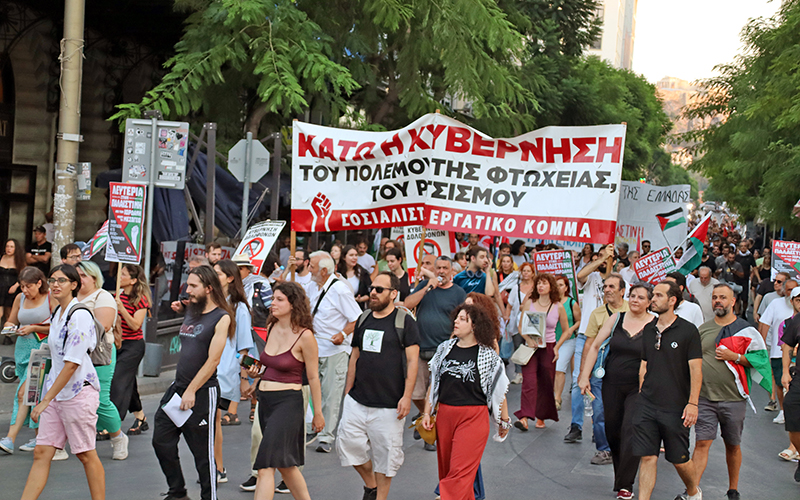
We are organizing the Thessaloniki International Fair demonstrations so that all the struggles can come together. That is what the Thessaloniki International Fair means for us. That is what the people heading to the demonstrations want. We held a meeting on Friday, August 28, which had precisely these characteristics. Activists from all fronts spoke: from many workers’ unions and from new struggles, such as people fighting over the issue of housing; from the anti-war movement and the solidarity movement with Palestine, the anti-racist movement, and migrant communities. All these movements will be at the Thessaloniki International Fair, and SEK will be there with them.
We have to connect with the thousands of people coming to Thessaloniki from all over Greece with one goal: to crush New Democracy. And we need to approach these people while recognizing all the contradictory consciousness that exists among them. We fight alongside these people, explaining to them that the solution will not come through the elections. We will get there too; we will fight that battle as well. But the solution lies in struggles and in strengthening the workers’ movement. The old way of organizing is no longer enough to confront developments and attacks.
The mobilizations at the Thessaloniki International Fair are not simply a two-day event on September 4 and 5. They are a first step that takes us into a new period, with all the new forces and possibilities we have. We have many new forces in workplaces. The way to acquire new forces was demonstrated by the campaigns carried out by the local branches through outreach to firefighters. We are obviously making similar openings in hospitals, municipalities, and everywhere.
We are changing
There are changes in our party. One change is that we have acquired a new branch in Rethymno. This means expanding our political work; this is the image of the dynamism of the branches, and under these conditions we are going to organize and strengthen this dynamism so that it can move to the center of all the fronts.
But beyond expansion, there is also the need to put down roots. We need to establish roots in more workplaces and universities. We have gained new forces on university campuses, but we need to put down even deeper roots because the battle in education is opening up in earnest in the autumn. The local branches have a role to play in putting down roots on campuses throughout the country. We need to connect meaningfully with schools, parents, teachers, and children.
The issue of housing needs to become a much more prominent part of our work. It is a huge issue. The other day we were talking to a comrade who said that the funds are taking her home. This is not happening to just one family. It is happening to a large section of the working class. This means that the people fighting for housing and the workers’ unions cannot be separate. We need to connect the movements and fight to dismantle the funds, for the nationalization of the banks without compensation for the bankers and under workers’ control.
There are no separate struggles. They are all connected, and it is the workers’ vanguard that makes these connections. The fight against sexism and transphobia means fighting to defend gynecological hospitals such as Elena and Alexandra. The fight against racism means the campaign to put the killers of Pylos and Syntiki, and Plevris himself, in prison. The fight against war and in solidarity with Palestine means the effort to organize a major international day of strikes and demonstrations on October 10, with workers’ unions at the forefront, following the path charted by the success of August 9.
We have to organize all these struggles and strengthen the revolutionary party even further. So that we can achieve what everyone wants: to crush the government and their system amid the greatest crisis.
A Rich Discussion
Experiences, conclusions, and a determination to organize characterized the dozens of contributions made during the discussion of the National Council of the SEK.
Local branches at the center
“We are a new branch, only four months old. Even so, we have managed to turn the whole city upside down,” said Vasso L. from the Rethymno branch enthusiastically, giving examples from the organization of the Pylos demonstration in June and the August 9 action for Palestine, “where we forced the entire Left to mobilize.” From the same branch, Maria I. described how she and her branch in the Cretan city became organized. “We organize with passion and self-sacrifice, and that is the secret of our success. I had never been organized, but from a certain age onward I was very concerned about what kind of society we would leave to the next generation. Joining the SEK came as a natural consequence.”
“There is a mutual exchange between the branches. Chania helped organize Rethymno, and vice versa,” noted Manolis F. from Chania, continuing with the activity of the municipal formation Antarsia in Chania and the organization of the August 9 action.
“The Nationwide Day of Action for Palestine on August 9 followed a series of struggles that unfolded during the summer, and we are already organizing the next stage, the demonstration at the Thessaloniki International Fair, together with all the fighting sections of the working class and youth. We need to strengthen our intervention in the trade unions,” stressed Kostas P. from the Peristeri branch.
“We took part in the demonstration against the visit of the Crown Iris on the eve of August 15, which built on the mood created by August 9 and the solidarity mobilizations for Palestine by the seafarers and dockworkers at Cosco. We do not forget the anti-fascist struggle, and we will all be present at the demonstration marking the anniversary of the murder of Pavlos Fyssas, on September 18 in Keratsini,” continued Mitsi M. from Piraeus.
Strike in schools
“In the summer the schools were closed, but the struggles continued. We had victories in Komotini, Tripoli, Athens, and elsewhere, with the most emblematic case being that of our colleague Chrysa Chotzoglou, who is returning to her school. These are victories that establish precedents and overturn the government’s narrative that it will impose evaluation by force,” pointed out Serafeim R. from the Kypseli branch, adding that “the agenda highlighted by struggles in workplaces is important and must not be underestimated.”
From the same sector, Anastasia P. from the Elliniko branch referred to the DOE (teachers' confederation) congress, where “we pushed for a 48-hour strike. And we won a decision for a 24-hour strike. We connected the struggles in education with those against war and racism, and that played a role. However, organizing the strike requires work because the trade-union leadership is trying to play it down.”
Katerina P. from the Petroupoli branch spoke about the SEK’s intervention in the healthcare sector. “Georgiadis, vice president of New Democracy and Minister of Health, continues to attack the ‘far left’ and the SEK. If the government itself recognizes that we are the real opposition, we need to organize our interventions and branches better and win over all those in our ranks who want to fight against Mitsotakis.”
Kostas K. from the Gkyzi branch added in the same vein that “routine is not enough. Political discussion has intensified in workplaces. The things we are saying here are being discussed in the hospital cafeteria where I work. We need to enter this political discussion boldly and provide organization and a perspective.”
“Our activity in Thessaloniki has been upgraded,” noted Giannis K., referring to the mobilization of workers at Hippokratio Hospital in Thessaloniki on the occasion of Adonis Georgiadis’s visit and the organization of the two-day campaign of struggle at the Thessaloniki International Fair.
Experiences from activity in workplaces and trade unions came from many comrades, including Alexis M. regarding the Greek Actors’ Union, Myrto M. from Aiginiteio Hospital, Maria N. from Primary Healthcare, Stefanos from the municipality of Palaio Faliro, Nikos T. from the Independent Authority for Public Revenue, Dimitris from the private sector in Koropi, Maria Ch. from Gennimatas General Hospital in Athens, and Eleni T. from the municipality of Nikaia–Rentis.
Outreach campaigns
“Workers’ resistance is continuing, and we have many connections with militant sections of the working class. We need to build this relationship politically as well. The branch and the newspaper play a decisive role in achieving this,” emphasized Tiana A. from the Piraeus branch.
“Consistency in our interventions plays a role,” said Sofia G. from the Galatsi branch, giving examples from the organization of migrant construction workers following the sector’s recent strike.
Anysia Tz. from the Keratsini branch referred to the recent outreach campaigns among firefighters, adding that “a large section of the working class did not go on holiday, and we were alongside them in the struggles they waged during this period of the summer.”
“We are in a period in which exceptional conditions are becoming permanent. This is what the war in Ukraine, the Middle East, and the disaster in Nepal show,” pointed out Giorgos P. from the Galatsi branch, continuing with a picture of resistance at the international level.
Sotiris K. from the Marousi branch brought up the picture of the economic crisis and the possibility that “2008 could happen again,” explaining the role played by the AI bubble and the war “which risks becoming generalized.”
Tasos T. from Thessaloniki spoke about the crisis of the opposition, which “leaves people without answers, people whom we need to win over.” “We will achieve this by opening fronts of struggle and fighting alongside these people,” he stressed, referring to the organization of the Thessaloniki International Fair and the international mobilization for Palestine on October 10.
Dimitris T. from the local branch brought the picture from the campaign alongside residents of Kypseli whose homes have suffered damage from Metro construction works, adding that “we do not set elections as a limit, and that is why we take the struggles all the way to the end and force sections of the reformist Left to move as well. We need to be more open to recruiting new members into the party.”
Lilian M. from the region of Western Athens also referred to August 9, when “the response to the hesitations of the reformist Left came from the people themselves who wanted to fight, and that is why the mobilizations were successful throughout the country. We need to work with these people every week. They want to fight on all fronts, but they will not do it alone. Political dilemmas are opening up, and we need to be there to provide the answers.”
Similarly, Lee from the Patisia branch spoke in detail about the decisive role played by the Stop the War Alliance in organizing the Nationwide Day of Action for Palestine, “despite the difficulties created by the hesitations of a significant section of the Left. We are continuing with the organization of October 10 by proceeding with a large open meeting of the Stop the War Alliance on September 20.”
“In Volos, the other sections of the Left underestimated the August 9 mobilization, so we took responsibility for organizing it ourselves,” noted Stavros from the local branch, confirming the picture presented by Lee.
Alexandros P. from the local branch gave an account of activity in the Kolonos neighborhood, providing examples of interventions in the catering, Metro, and actors’ sectors.
Iris from the Nea Smyrni branch referred to the struggle of the student movement on university campuses and added an account of the recent mobilization at the National and Kapodistrian University of Athens in solidarity with the Palestinian people.
Anti-fascist and anti-racist action
“The threat of fascism is once again real,” stressed Nikos P. from Patisia, speaking about the recent racist attack against Pakistani workers in the neighborhood and the actions being planned by the local KEERFA in response.
“The anti-fascist struggle is the most important issue at the moment. We must not forget the provocation of Kasidiaris’s release from prison as we mark 13 years since the murder of Pavlos Fyssas,” added Kostas K. from the Peristeri branch.
“Internationalism means transmitting the revolutionary experiences that comrades coming from other countries have, and turning them into lessons for our own activity,” emphasized Minas Ch. from Zografou, highlighting the initiatives taken by the local branch to facilitate communication with migrant workers.
“We are making a major effort to strengthen and expand the branch’s activity. We need constant feedback from the people we interact with,” noted Georgina P. from the Agia Paraskevi branch.
Argyri Er. and Kostas K. spoke about the initiatives of the Kallithea branch following transphobic attacks in the preceding period, noting that these initiatives served both to provide an immediate response, open up political discussion with large numbers of people, and organize new members into the SEK.
Afroditi F. conveyed the experience of organizing the Nea Ionia branch, recalling that it has been two years since the killing of Mohammed Kamran at the Agios Panteleimonas police station, “a struggle we had taken up together with the Pakistani Community in our neighborhood and which we need to continue.”