

When Trump boasted that he was “the President who stops wars,” he certainly did not mean the humiliating way in which he is now trying to come to terms with Iran, tacitly acknowledging his resounding defeat. Perhaps, if he had taken a private history lesson from the late Eden, he might have avoided this fiasco.
Anthony Eden was Prime Minister of Great Britain in 1956 when, together with his French counterpart Guy Mollet, he presided over the most spectacular failure of Anglo-French imperialism against one of their former colonies, Egypt, centered on the strategically vital Suez Canal.
Since 1954, Gamal Abdel Nasser had been at the head of power in Egypt. A military officer and hero of the 1948 Arab-Israeli War, his record up to that point had been contradictory, both toward the imperialist powers and toward Egypt's labor movement. On the one hand, he bargained with the United States while imprisoning communists; on the other, he promoted “Arab socialism” and supported Algeria's National Liberation Front.
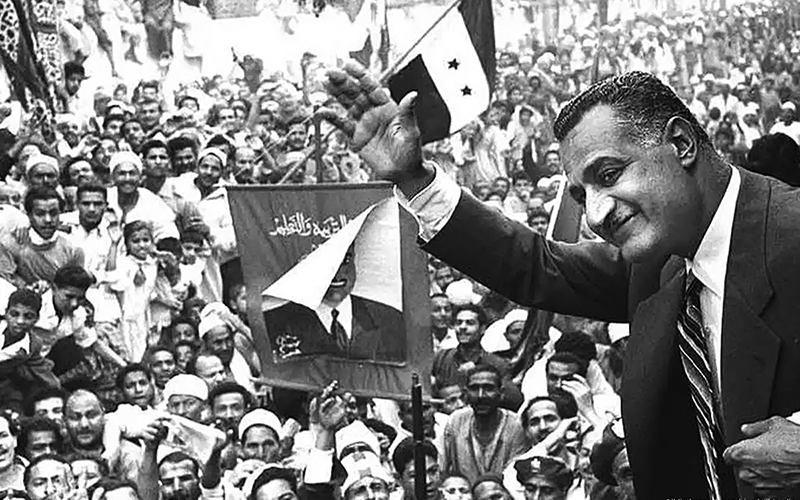
However, when the United States decided in July 1956 to withdraw its funding for the construction of the Aswan Dam, Nasser hurried to announce before a vast crowd the nationalization of the Suez Canal. For the British and the French, this was the last straw.
At a secret meeting in Sèvres, British, French, and Israeli officials devised their plan: an Israeli attack on the Sinai Peninsula would trigger an ultimatum calling on both the Israeli and Egyptian armies to withdraw from the canal zone. Confident that Nasser would reject such terms—abandoning both the peninsula and the canal—the British and French would then bomb Egyptian cities and land troops at Port Said to seize control of the canal's entrance.
The Israelis would be generously rewarded. The French were already supplying them with weapons, and at Sèvres they also agreed to provide nuclear technology and uranium for a future nuclear reactor at Dimona.
On October 29, Israeli forces invaded the peninsula. As the Egyptian army moved to confront the invaders, Britain and France demanded a ceasefire. The Israeli attack caught the Egyptian military leadership by surprise. Nasser had expected the initial thrust to be toward Alexandria. The Sinai garrison had been reduced to 30,000 men, of whom only 10,000 were frontline combat troops, while much of the abundant Soviet weaponry had not yet become operational. Despite these difficulties, Egyptian units in Sinai fought bravely, and Israeli paratroopers dropped at the Mitla Pass suffered significant losses.
Bombs
Once the Anglo-French forces joined the offensive, however, the balance tipped decisively against the Egyptians. Before nightfall on October 31, the first British bombs were falling on Cairo, and within hours they had destroyed the Egyptian air force. Six days later, British troops landed at Port Said, at the entrance to the canal, while the French captured Port Fouad on the opposite bank.
The three allies' plan appeared well designed, and its success seemed assured. Surprise and military superiority would give them control of the area; Egypt's already fragile economy would quickly be
strangled; and the aristocracy hostile to Nasser, together with disillusioned military officers, would swiftly overthrow him, paving the way for a more compliant regime.
But they had reckoned without the people. Egypt's working class and peasantry not only refused to line up behind the Anglo-French collaborators, but rushed to obtain the hundreds of thousands of rifles and smaller arms that Nasser, seeing the army's failure, had wisely decided to distribute by truck. The Sèvres plan would not withstand for long the mass guerrilla war that was already taking shape and already inflicting casualties in the neighborhoods of Port Said.
Within the Popular Resistance Committees that were formed, communists played a decisive role both in rapidly training young people militarily in factories and universities and in organizing resistance networks in local neighborhoods. The communists whom Nasser was compelled to release from prison went directly to the factories to organize militias.
At the same time, the invaders would face another front. A mass anti-imperialist solidarity movement first erupted in Iraq and quickly, aided by police repression, turned into a broader movement against the pro-British Iraqi government. Massive demonstrations and clashes broke out in Baghdad, Basra, Najaf, Mosul, and elsewhere. The government declared a state of emergency, but the protests continued unabated. The danger that the British might lose control of Iraq as well—and of its vast oil reserves, as indeed happened two years later—became increasingly real.
The anti-war movement would soon reach Britain itself. In London on November 4, tens of thousands of demonstrators flooded Trafalgar Square chanting “No war” and “Down with Eden.” Seafarers distributed leaflets en masse calling for strike action against the war, and as the march headed toward Downing Street it ended in large-scale violent clashes with the police. It was the largest demonstration of the postwar era, while anti-war protests also broke out in other smaller industrial towns.
Failure
Meanwhile, Britain's and France's attempt to maintain control over parts of the Middle East and North Africa that had long been treated as their private domains meant that the invasion had been organized without American approval. This challenge to U.S. hegemony was something Eisenhower, then President of the United States, might have tolerated had they at least achieved their military objectives quickly. But the instability their failure threatened to unleash across the Middle East—jeopardizing efforts to build an anti-Soviet alliance in the region—led the United States to join the Soviet Union in proposing a United Nations Security Council resolution condemning the invasion and demanding an immediate ceasefire and the withdrawal of foreign troops.
Faced with mass resistance, the sharp collapse of sterling, and mounting pressure on all these fronts, Britain and France were forced on November 7 to halt their attacks and withdraw completely from the canal zone before the end of the month. The impact of this defeat was enormous. Over the following years, the two great powers would withdraw from dozens of former colonies in the face of anti-colonial resistance movements, for which Nasser remained a symbol.
The new regimes proceeded with nationalizations and land redistribution, improving the lives of ordinary people. Yet power remained in the hands of an elite of bureaucrats and military officers who defended their own interests whenever workers and peasants demanded more, while the Left ultimately became an appendage of these regimes. Oriented toward alliances with the Soviet Union,
it preferred bargaining with the new ruling classes over the prospect of workers' struggles and revolutionary overthrow, leaving it incapable of resisting the neoliberal turn of the 1970s.
Today, seventy years later, the imperialist power in crisis is the United States. The leveling of Gaza and the genocide carried out by its rabid attack dog not only failed to strengthen its position after the defeats of previous decades in Iraq and Afghanistan, but led Trump to believe that war with Iran would be an easy affair.
“Military superiority,” “economic strangulation,” “internal enemies,” and a “popular uprising against the mullahs”—the same old mistakes... Nothing worked according to plan. American bases in neighboring countries came under attack, and the United States suffered a military failure in Iran despite its intense aerial bombardment. The closure of the Strait of Hormuz threatened a global economic crisis, while unilateral U.S. actions were met with disapproval from China and Russia.
Mass anti-war movements emerged from New York to London, and at the same time, in Iran, the movements that had previously struggled against the regime understood perfectly well that American bombs would not liberate them from the Khomeinists—even when those bombs struck them directly.
The flame of the Palestinian resistance, which refuses to die out, continues to set fires beneath the imperialists, and the defeat in Iran may open the door for those below to rid themselves not only of the imperialists but also of their own oppressive ruling classes.